How Subhadra Metals makes propeller patterns a 3-axis router can’t

CASE STUDYBy Shrey Patel · Reviewed by Dipalkumar Koladia
Subhadra Metals, a foundry that casts marine propellers in special alloys, could only cut oversized propeller patterns on its 3-axis router and found 5-axis machines too costly. It now 3D prints the complex blade sections on GO3D printers and cuts simple bases from wood on the router it already owned. The change saves about ₹75,000 a month in pattern costs and leaves about 2 mm less metal to grind off each surface of the casting.
₹75,000
a month saved on patterns
2 mm
less metal to grind off each surface
5,000+
hours printed on two GO3D printers
At a glance
| Item | Detail |
|---|---|
| Customer | Subhadra Metals Pvt. Ltd., marine propeller and special-alloy foundry, Khalapur, Maharashtra |
| Challenge | Propeller patterns need 5-axis machining; the shop had a 3-axis router |
| Solution | Hybrid patterns: simple bases cut in wood on the router, complex sections 3D printed, then joined |
| Printers | GO3D Artish 700 and BX 1200 |
| Pattern cost saved | About ₹25,000 a month with the Artish 700 and ₹50,000 a month with the BX 1200, about ₹9 lakh a year combined |
| Grinding | About 2 mm less stock to grind off each surface; the alloy costs ₹400–500 per kg |
| Printing so far | About 3,000 hours on the Artish 700 and 2,000 hours on the BX 1200 |
About Subhadra Metals
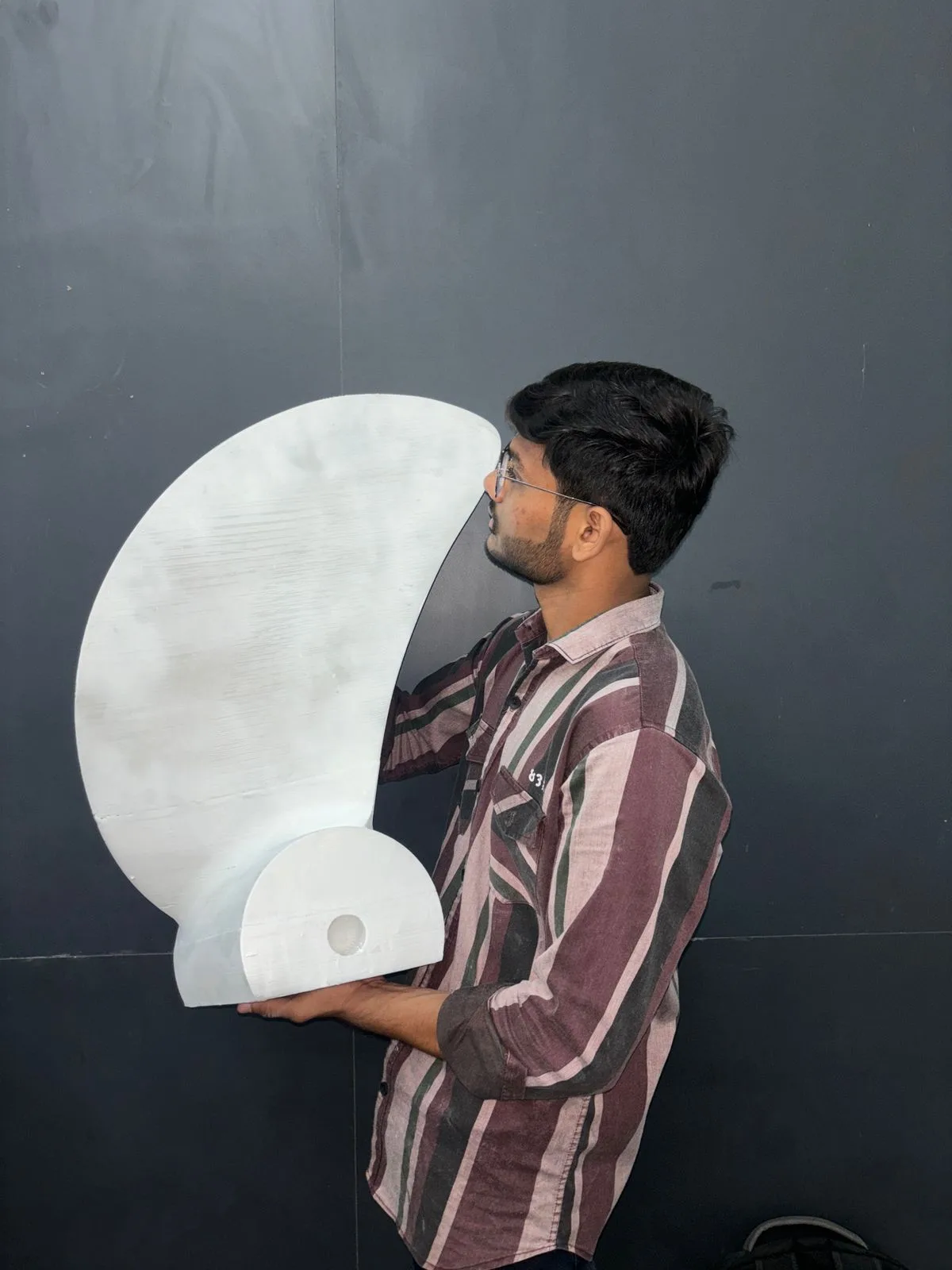
Subhadra Metals Pvt. Ltd. casts special alloys for the marine industry, including ship propellers, at its foundry in Khalapur, Maharashtra. Its propeller blades stand around 1,500 mm high.
Propellers are among the hardest patterns a foundry makes. Each blade is a twisted, curved surface, and the finished casting has to match the design closely, because blade shape decides how well the propeller performs.
Why a 3-axis router wasn’t enough
Subhadra made its patterns on a 3-axis CNC router. A 3-axis machine cuts from above, so it cannot reach under the overlapping, twisted surfaces of a propeller blade. Cutting the true blade shape needs a 5-axis machine, and in India a 5-axis router is a large investment, so Subhadra did not buy one.
“Earlier, we didn’t have a 5-axis router, so we had to use extra material to compensate when working with our 3-axis router.”
Aditya, Head Engineer, Subhadra Metals
The old way: oversize, cast, grind, repeat
Without a 5-axis machine, the shop worked around the problem:
- Cut a simplified pattern with extra material on the 3-axis router, so the true blade shape sat inside it.
- Cast the propeller from that oversized pattern.
- Grind the casting by hand towards the final blade shape.
- 3D scan it and compare it with the design.
- If it was out of tolerance, grind and scan again until it qualified.
Every millimetre of extra stock was alloy that had been melted, poured and then ground away. Every grind-and-scan loop added hours of skilled labour, and how many hours depended on the propeller’s size and the grinder’s skill.
First attempt: print everything
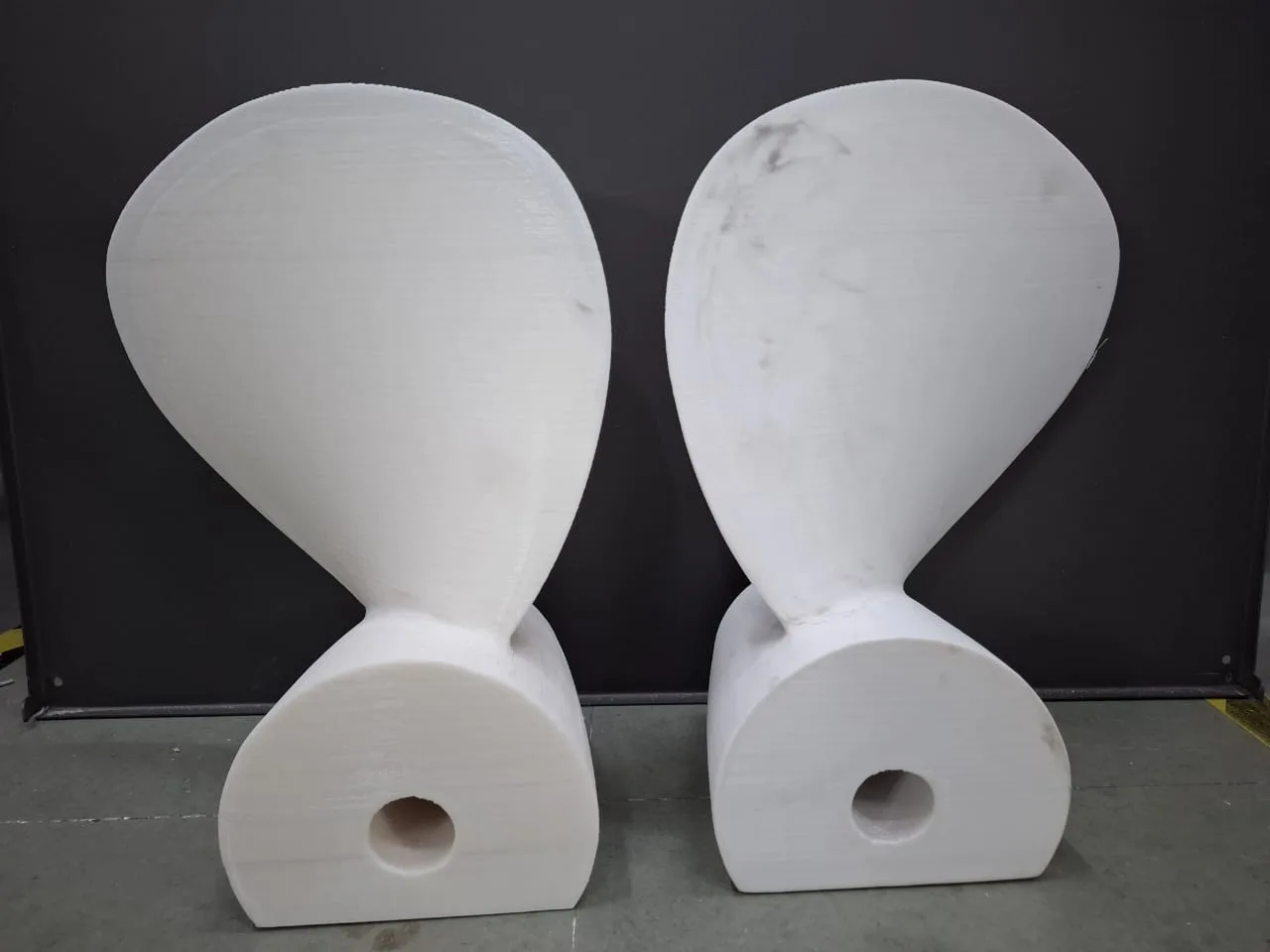
Subhadra’s first GO3D printer was an Artish 700, with a 700 × 500 × 500 mm build volume. For the first time the shop could make a propeller pattern in its exact final shape, including the blade surfaces the router could not reach. At first the team printed every pattern and set the router aside.
“We first saw a 3D printer at an exhibition and felt that this technology could be really useful for us, so we decided to give it a try.”
Aditya, Head Engineer, Subhadra Metals
After some time, Subhadra’s engineers concluded that this was not the best use of either machine. A propeller pattern’s base is a simple cylinder that the router cuts quickly. The base also carries the screws used to lift the pattern, so a printed base would need high infill for strength and would take much longer to print. Their answer was to use both: the router for the simple shapes it already handled well, and the printer for the geometry only it could make.
Today: wood base, printed blades
- Split the pattern. Engineers separate the simple base, such as a cylindrical hub, from the complex sections, such as the propeller blades.
- Cut the base in wood on the existing 3-axis router.
- Print the complex sections on a GO3D printer: the Artish 700 for smaller patterns, the BX 1200 for larger ones.
- Join the two into one pattern. They are bonded with Araldite epoxy adhesive.
Because the pattern now has the true blade shape, the casting needs far less grinding.
Results
| Area | What changed |
|---|---|
| Pattern cost | About ₹25,000 a month saved with the Artish 700 and ₹50,000 a month with the BX 1200: about ₹75,000 a month, or ₹9 lakh a year, together. The exact saving varies with the design. |
| Grinding | About 2 mm less stock to grind off each surface, so each casting is finished sooner. The time saved depends on part size and the grinder’s skill. |
| Alloy | Less metal melted, poured and then ground away. The alloy costs ₹400–500 per kg. |
| Machine use | About 3,000 printing hours on the Artish 700 and 2,000 on the BX 1200, the equivalent of about 125 and 83 days of non-stop printing. |
What 2 mm is worth. On every square metre of blade surface, 2 mm of extra stock is 2 litres of metal. Subhadra’s alloy is close to mild steel in density, about 7.85 kg per litre, so that is about 16 kg, or roughly ₹6,300–7,900 of alloy at ₹400–500 per kg, before counting grinding labour.
“Today, both machines have become workhorses for us. They’ve made a real difference in the way we work, and GO3D has been incredibly supportive throughout this journey. We’re really happy with the technology and the support we’ve received from the GO3D team.”
Aditya, Head Engineer, Subhadra Metals
Scaling up to the BX 1200
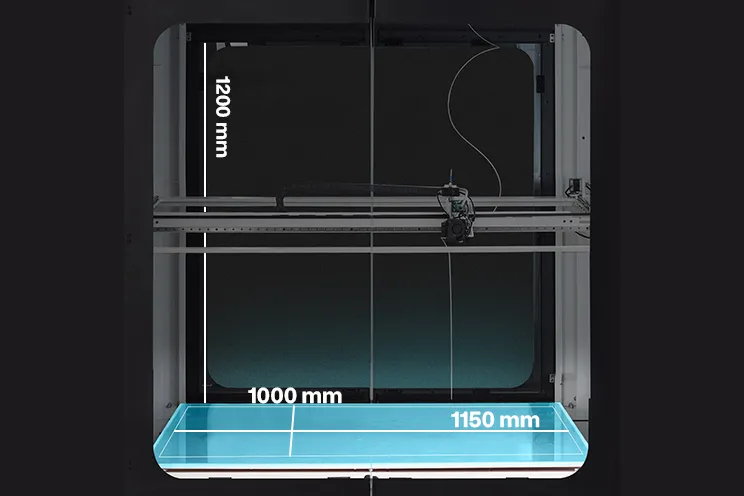
Once the hybrid method had proved itself, Subhadra bought a GO3D BX 1200 for bigger propellers and patterns. Its 1150 × 1000 × 1200 mm build volume is about eight times that of the Artish 700, so much larger blade sections can be printed. The BX 1200 now delivers two-thirds of the monthly saving: ₹50,000 of the ₹75,000.
“We purchased the Artish 700, and honestly, the results were so satisfactory that we went ahead and purchased their biggest machine, the BX 1200, as well.”
Aditya, Head Engineer, Subhadra Metals
Subhadra now runs the Artish 700 and the BX 1200 alongside its 3-axis router.
Print setup
| Setting | Value |
|---|---|
| Printers | Artish 700 (700 × 500 × 500 mm), BX 1200 (1150 × 1000 × 1200 mm) |
| Slicer | GO3D Transform |
| Pattern material | PLA Pro |
| Nozzle | 0.6, 1.0 and 1.4 mm, depending on the pattern design |
| Joining to the wood base | Araldite epoxy adhesive |
Frequently asked questions
Can an FDM 3D printer make patterns for marine propeller casting?
Yes. Subhadra Metals prints propeller blade sections on GO3D Artish 700 and BX 1200 printers and casts from them. Printing reproduces the twisted blade surfaces that a 3-axis router cannot reach.
Is 3D printing cheaper than buying a 5-axis CNC for patterns?
For Subhadra it was: a 5-axis router was too costly, while its printers save about ₹75,000 a month in pattern costs. For other foundries the answer depends on pattern sizes and volume.
Why not print the whole pattern?
Subhadra tried that first. Its engineers found it better to cut simple shapes, such as a cylindrical base, in wood on the router they already owned, and print only the complex sections. The base is quick to cut and carries the screws used to lift the pattern; printing it would take longer and need high infill for strength.
Which GO3D printer suits large propeller patterns?
The BX 1200, with a 1150 × 1000 × 1200 mm build volume, is the printer Subhadra bought for its bigger propellers. Smaller patterns run on the Artish 700 (700 × 500 × 500 mm).
About this case study
The information comes from GO3D’s work with Subhadra Metals and was reviewed by Subhadra Metals and by Dipalkumar Koladia of GO3D. Savings figures are Subhadra’s own estimates. Machine specifications come from GO3D’s product pages. “What 2 mm is worth” is an illustrative calculation.
Related: 3D printers for foundry patterns · Ganga Thermopack aluminium casting patterns case study
Making patterns for complex castings? Share a pattern drawing below and our team will suggest the right printer, material and settings.
Written by Shrey Patel, GO3D, and reviewed by Dipalkumar Koladia.


Let’s set the ball rolling with your next project
Get in touch with our team
